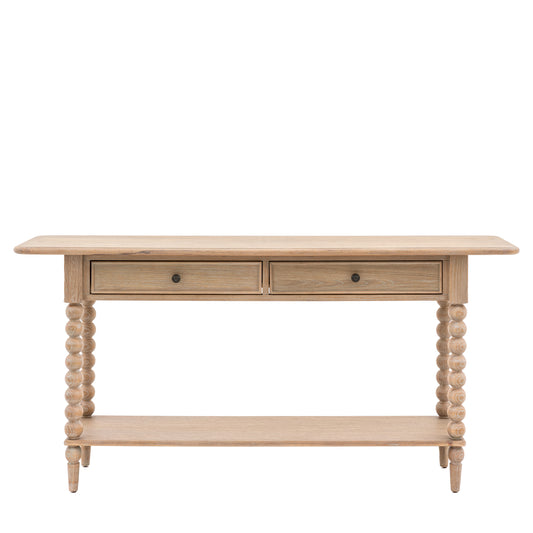
A demi lune console table uses a half-moon front rather than a straight edge, which softens a hallway and works particularly well against a curved stairwell or in a corner where a straight-fronted table would jut out further into the walkway. This shape trades a small amount of surface area for a genuinely different silhouette, so it suits a space where the console table needs to be noticed as a design feature rather than sit quietly in the background.
A console drawer table isn't purely decorative. Several designs in this range include one or two drawers, giving you console table for storage use beyond just a display surface, useful for keys, post, or anything else you want out of sight but within reach near a front door. A design without drawers suits a purely display-led spot instead, such as beneath a large mirror where the surface itself is doing the visual work.
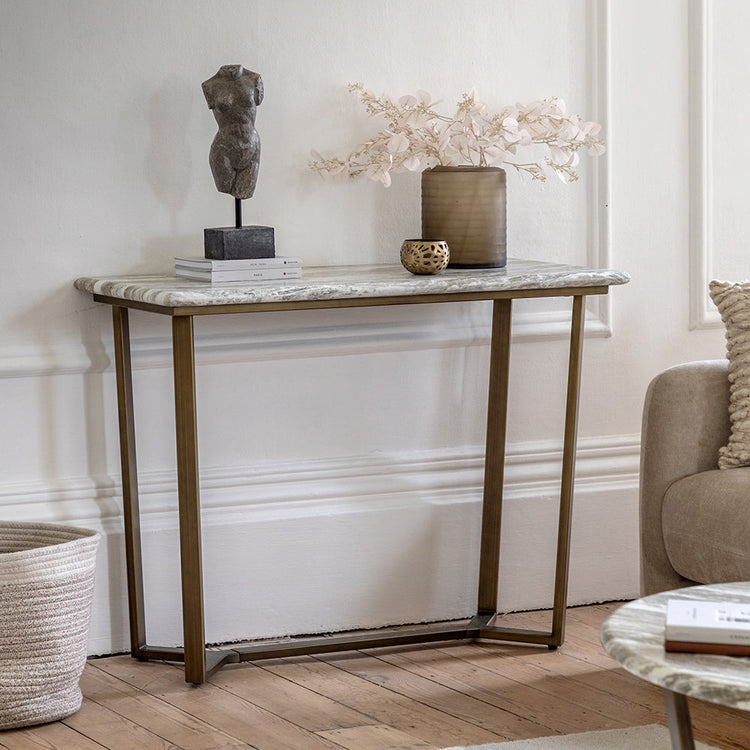
A marble top console table pairs a natural stone surface with a wood or metal-detailed base, giving a more contemporary edge to an otherwise classic silhouette. The marble console table top catches light differently to a painted or wood surface, which makes it particularly effective under a mirror or pendant light where the reflective quality gets noticed. This finish tends to suit a genuine luxury console table position, such as a formal hallway or a living room wall meant to draw the eye.
Contemporary console tables in this range lean into cleaner lines and simpler detailing than a fully classic design, suited to a room already built around modern furniture elsewhere. A modern console table with visible metal legs or trim reads differently to one with a fully wood-panelled base, so it's worth matching the console table's overall style to whatever else is already established in the room rather than choosing it in isolation.
A console table small enough for a narrow hallway won't necessarily suit a larger living room wall, and the reverse is just as true. Measure the available wall length and the depth of the walkway in front of it before choosing a size, since a console table small enough to sit flush against a tight hallway wall might look genuinely undersized in a more open room. A large console table needs a correspondingly generous wall to avoid crowding the space, so match scale to the room rather than to the piece alone.
Console table uk buyers need often comes down to the shallow depth of a typical British hallway, which tends to be narrower than equivalent spaces in other markets, particularly in period housing. Console tables uk shoppers pick for this kind of space usually prioritise a shallow profile over surface area, since a table that projects too far into a hallway becomes an obstacle rather than a convenience, regardless of how good it looks against the wall itself.
A marble top needs slightly different upkeep to a painted or wood surface, since the stone can absorb spills if left too long, so wiping up liquids promptly matters more here than on a sealed wood finish. A natural finish or wood-panelled console table generally just needs regular dusting, though it should be kept away from direct heat sources like radiators to avoid the wood drying out or warping over time. Whichever finish you choose, positioning the console table away from prolonged direct sunlight helps prevent uneven fading across the surface, particularly on darker or richly coloured tops where colour changes show up more visibly than on lighter finishes.
Yes, the stone surface adds noticeable weight compared to a fully wood or metal top, so confirm the final position before delivery rather than planning to move it around often afterward.
Some, since the curved front reduces the overall footprint slightly, though this is usually a worthwhile trade-off for the shape it brings to a corner or curved wall.
Check the table's full depth including the drawer fronts, not just the tabletop measurement, since some designs project slightly further once you account for drawer hardware.
It can create a deliberate contrast rather than a clash if the rest of the room has at least one other piece with a similar clean-lined finish to anchor it.
Depth varies by design, so measure your hallway's clear walkway width first and check the specific product dimensions against it rather than assuming a standard depth applies across the range.